
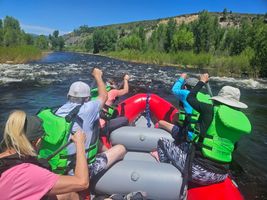
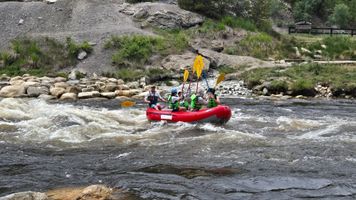
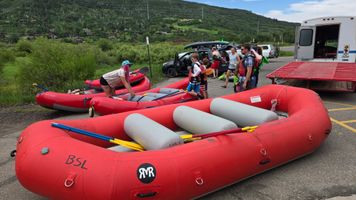
The Rafting Experience
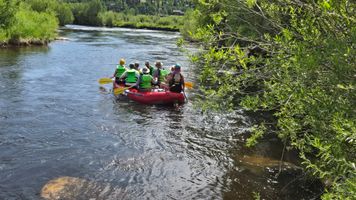
The Yampa River Town Run is a pleasant, Class 2 section. The ranging flows of the spring run off provide for an exciting, splashy run. This section of river is great for beginners and experienced boaters a like. Expect to get wet and have a lot of laughs!
Your experience will start at Backdoor Sports on Yampa street. From there, you will meet your guide and get outfitted with PFDs (life jackets) along with river shoes and splash gear as needed. Then, we shuttle you up river to the put in. A thorough safety briefing is delivered by our guides while on the shuttle. Once at the put in, we will unload boats and get them in the water. As a part of the rafting experience, you are able to participate in this process but by no means expected to do so.
To begin, there is a stretch of flat water, allowing for time to get acquainted with your guide, boat, paddle and to cover any additional safety information. During this time, you may also enjoy stunning views of Steamboat Resort (Mt. Werner), Howelson Hill and the surrounding area. This scenery may be appreciated from the river from a more uniquely imersive perspective. After soaking in the views, it is time to experience the Yampa River Town Run. This section of the river is designed to be safe and enjoyable, featuring a handful of class 2 rapids. From there, the river mellows back out until the takeout where you will be greeted by our friendly shuttle drivers that will transport you back to Backdoor Sports.
About The Yampa River
The Yampa River has long been the defining natural feature of Steamboat Springs, shaping both the town’s history and its modern identity as a river-centric community. For centuries before U.S. settlement, the Yampa Valley was inhabited by the Yampatika Ute and other Indigenous peoples. This valley served as seasonal hunting and gathering grounds. The mineral springs and waters of the Yampa Valley were considered sacred and healing.
The river itself rises in the Rocky Mountains and flows roughly 250 miles to join the Green River, making it part of the larger Colorado River Basin. What makes the Yampa especially significant in the American West is that it remains one of the few largely free-flowing rivers, with minimal dams or diversions, allowing it to behave much as it did naturally. This natural flow supports floodplains, wildlife habitat, agriculture and a variety of fish species. Because most Western rivers are dammed and allocated, the Yampa is often described as one of the last relatively “wild” tributaries of the Colorado River system.
As Steamboat Springs grew into a recreation-focused town in the late 20th century, the Yampa River and waters of the Yampa Valley became central to tourism and local culture. They are still considered sacred and healing. The stretch through downtown naturally contains mild, class 2 rapids. Many of the distinct “play features” seen today have been engineered and enhanced over the years. Structures such as rock weirs and drops were installed in the river channel. These were designed to shape flow into consistent standing waves and “holes” ideal for kayaking, white water rafting, tubing and other enjoyable river sports.
Famous features, such as “D-Hole” and “Charlie’s Hole”, are focal points for playboating as well as competitions. The motivation behind building these whitewater features serves many purposes:
~Recreation: Creating reliable waves for kayakers, boaters, tubers and surfers at varying flow levels
~Economic and educational development: Attracting visitors and events, such as the annual Yampa River Festival, in order to promote flourishing economic practices rooted in awareness, respect and conservational stewardship
~River management: Stabilizing banks and navigating water flow
The Yampa River is significant for Steamboat and beyond for several reasons:
~Last free-flowing tributary: It is a rare example of a minimally dammed river in the Colorado River Basin, which is critical for ecological health.
~Water supply and agriculture: It supports our water needs as well as much of the valuable ranching and farming water supply needs in northwestern Colorado.
~Biodiversity: Its natural flow regime sustains endangered fish and riparian ecosystems not found on heavily managed rivers.
~Recreation economy: In Steamboat, the Yampa River drives fishing, boating, tubing, kayaking and much more, making it central to the town’s identity and tourism. In short, the history of the Yampa River in Steamboat Springs is a blend of natural preservation and mindful modification. While engineered whitewater features have made it a premier recreational river, its broader importance lies in remaining one of the West’s last truly free-flowing waterways, an increasingly rare and valuable resource in a more heavily managed river system.